Within Schleswig Holstein UFOs
How Fireball Records Help Explain UFO Sightings
Fireball data helps separate natural sky events from reports that need other explanations.
On this page
- What the fireball count adds
- Why meteors can surprise witnesses
- Matching reports against sky monitoring data
Page outline Jump by section
Introduction
Fireballs matter in Schleswig-Holstein’s UFO record because they give investigators a clean way to separate some dramatic sky reports from the smaller number that need other explanations. The state-level Ufokarte page lists 243 investigated UFO or UAP cases for Schleswig-Holstein, 2 unresolved cases, and 210 fireballs registered over the state by the Global Meteor Network. That does not make meteors the answer to every unusual light in the northern sky, but it does show that natural atmospheric events are a major comparison set for any serious local UFO analysis.[Ufokarte.de]ufokarte.deUF O-Sichtungen in Schleswig-Holstein — Ufokarte.deUF O-Sichtungen in Schleswig-Holstein — Ufokarte.de
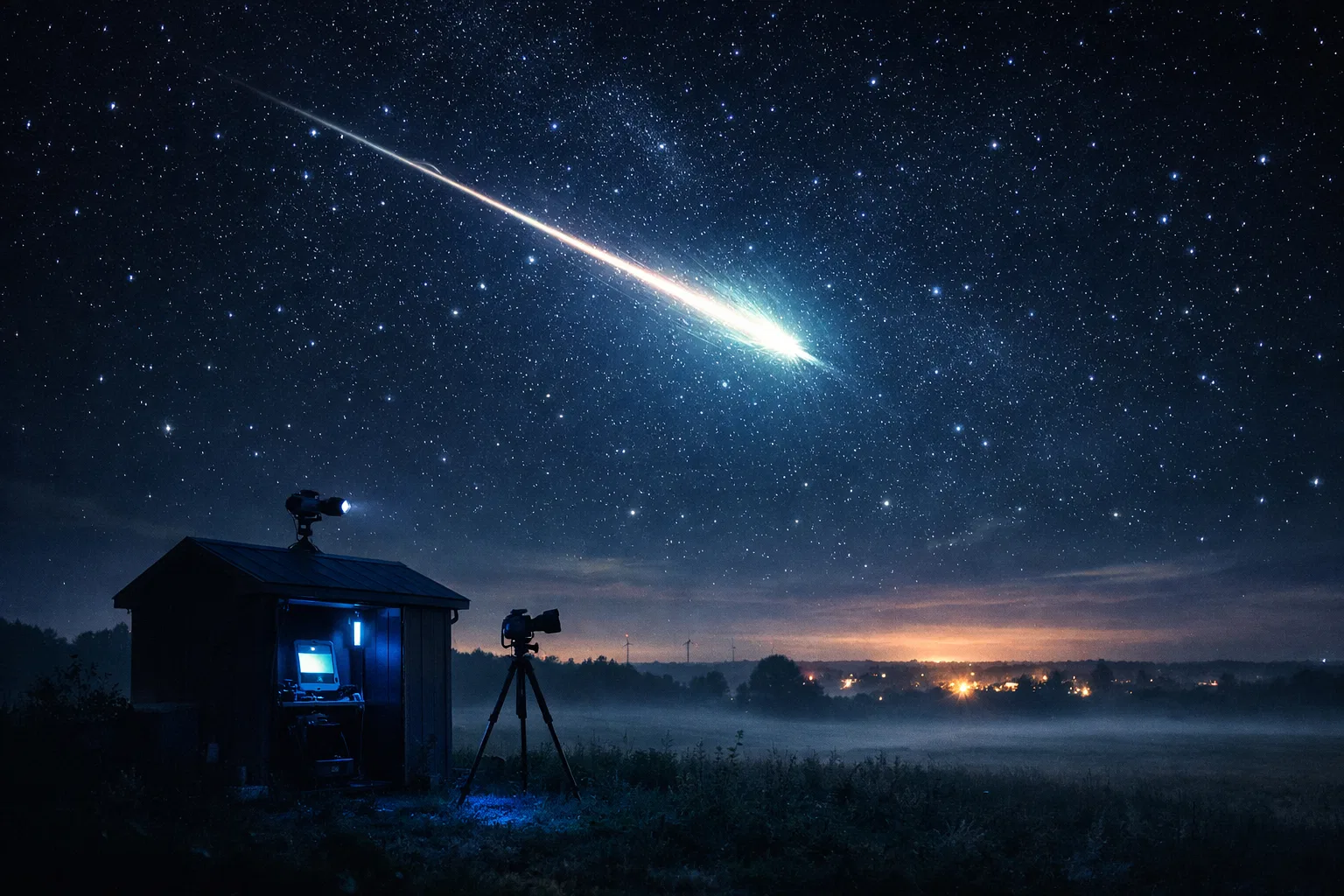
A fireball is a very bright meteor: a small natural object entering the atmosphere fast enough to glow, fragment, leave a trail, or briefly light up the sky. To a witness in Kiel, Flensburg, Lübeck, Fehmarn or along the North Sea coast, such an event can look sudden, silent, low, artificial or even structured. The value of the Global Meteor Network record is practical rather than sensational. It gives researchers timed, instrument-based sky data that can be checked against human reports before a case is treated as truly puzzling.
What the fireball count adds
The figure of 210 Global Meteor Network fireballs over Schleswig-Holstein should be read as a comparison dataset, not as a UFO count. It represents recorded natural sky events that were bright enough, well-placed enough, or suitably captured by meteor cameras to enter the fireball layer used by Ufokarte. In the same state summary, the UFO or UAP side of the record is based on investigated GEP cases, while the fireball layer is separately attributed to the Global Meteor Network.[Ufokarte.de]ufokarte.deUF O-Sichtungen in Schleswig-Holstein — Ufokarte.deUF O-Sichtungen in Schleswig-Holstein — Ufokarte.de
That separation is important. A UFO database starts with a witness problem: someone saw something they could not identify. A meteor network starts with an observation problem: cameras detect meteors and calculate properties such as direction, track and timing. When the two records overlap in time and place, investigators gain a useful test. A bright, brief object reported by witnesses at the same time as a recorded meteor is less mysterious than an isolated report with no matching astronomical, aviation or satellite explanation.
For Schleswig-Holstein, this is especially useful because the state has many settings where a brief light can feel more extraordinary than it is. Coastal horizons, dark rural skies, ferry routes, offshore lighting, aircraft paths and summer tourism all increase the chances that ordinary sky events will be noticed by people who are not expecting them. The Global Meteor Network does not remove uncertainty from every case, but it gives a baseline: before treating a fast light or glowing trail as a possible UAP, check whether the sky itself already produced a documented fireball.
The count also helps correct a common misunderstanding about UFO records. A large number of unusual-sky reports does not automatically imply a large number of exotic events. Schleswig-Holstein’s public listing shows many investigated cases, very few marked unresolved, and a separate stock of natural fireball records. That combination points towards a broad observation culture, not a hidden pattern of confirmed anomalous craft.[Ufokarte.de]ufokarte.deUF O-Sichtungen in Schleswig-Holstein — Ufokarte.deUF O-Sichtungen in Schleswig-Holstein — Ufokarte.de
Why meteors can surprise witnesses
A meteor can be startling because it is brief, bright and poorly matched to everyday expectations. People often expect aircraft to move steadily, satellites to drift silently, and drones to hover or manoeuvre. A fireball does something different: it may flash into view without warning, cross a large part of the sky in seconds, change colour, fragment, leave a glowing trail, or seem to descend towards the ground. Those features can easily produce sincere UFO reports.
The Global Meteor Network describes its aim as observing meteors with a worldwide network of cameras pointed at the night sky. Each station uses a camera connected to a Raspberry Pi running open-source software for video capture, compression and meteor detection. In plain terms, it is a distributed sky-monitoring system, not a witness hotline.[globalmeteornetwork.org]globalmeteornetwork.orgWhat is the GMN?Global Meteor Network…
The network’s scientific paper explains why this matters. The GMN uses sensitive, low-cost video cameras and automated software to measure meteors. By 2021 it had more than 450 cameras in 30 countries, with a goal of characterising meteor shower radiants, flux and size distribution, and it had collected more than 220,000 precise meteoroid orbits between December 2018 and June 2021.[OUP Academic]academic.oup.comOUP Academic…
For UFO investigation, the key word is not “global” but “measured”. A witness may remember a light as slow, nearby or hovering, especially if there are no clouds, trees or buildings to provide scale. A camera network can place the event in a wider sky geometry. When several stations capture the same meteor, analysts can estimate its path through the atmosphere rather than relying only on human distance judgement, which is notoriously weak for isolated lights in a dark sky.
This is particularly relevant in Schleswig-Holstein because open coastal views can exaggerate ambiguity. A fireball seen over the Baltic Sea or North Sea may appear to be above a local village, a ship route or a wind farm, when it is actually tens or hundreds of kilometres away. The witness report is still valuable, but it needs to be interpreted alongside time, bearing, duration and independent sky records.
The Flensburg fall shows why fireballs belong in the state’s UFO history
The strongest Schleswig-Holstein example is not an alien-claim case at all. It is the Flensburg meteorite fall of 12 September 2019, a scientifically important daylight fireball that ended with a real meteorite recovered in the city. The Meteoritical Bulletin records Flensburg as an official meteorite name, an observed confirmed fall in Germany, with a mass of 24.5 grams and a classification of C1-ungrouped carbonaceous chondrite.[LPI]lpi.usra.eduLPIMeteoritical Bulletin: Entry for FlensburgLPIMeteoritical Bulletin: Entry for Flensburg
The event was widely witnessed. The bulletin states that the bolide was observed at 12:49:48 UT by hundreds of eyewitnesses from the Netherlands, Germany, Belgium, Denmark and the UK. It was also registered by an all-sky meteor camera in Herford, with additional casual video recordings from dash and security cameras in the Netherlands and Germany. A small meteorite fragment was found the next day in a private garden in Flensburg.[LPI]lpi.usra.eduLPIMeteoritical Bulletin: Entry for FlensburgLPIMeteoritical Bulletin: Entry for Flensburg
This case matters for UFO history because it shows how a dramatic aerial event can be both extraordinary and entirely natural. A daylight bolide seen across several countries could easily generate urgent reports of an unexplained object, especially if witnesses heard noise, saw fragmentation, or misjudged its distance. Yet the combination of camera data, videos, recovered material and laboratory classification moved the event from “strange thing in the sky” to a well-documented meteorite fall.
The scientific analysis of the Flensburg trajectory strengthens that point. Researchers reconstructed its atmospheric trajectory, velocity and orbit using a dedicated meteor camera and three casual video records. They estimated that the original meteoroid was far larger than the recovered stone, with heavy fragmentation in the atmosphere and only a very small part reaching the ground.[arXiv]arxiv.orgarXiv Trajectory and orbit of the unique carbonaceous meteorite FlensburgarXiv Trajectory and orbit of the unique carbonaceous meteorite Flensburg
For Schleswig-Holstein, Flensburg is a useful anchor because it prevents two opposite mistakes. It shows sceptics that witnesses can report a genuinely spectacular event accurately enough to matter. It also shows UFO enthusiasts that spectacular does not mean anomalous. The event was real, memorable and scientifically valuable, but its explanation was meteoritic.
Matching reports against sky-monitoring data
The practical use of fireball records is a matching exercise. An investigator starts with the witness account and asks whether the reported time, direction, duration and appearance fit a known meteor or fireball. A good match does not require every detail to be perfect, because human estimates of height, distance and speed are often unreliable. It does require the overall pattern to fit.
A strong meteor match usually has several features:<div class="content-enhancement content-enhancement--metric" markdown="1">
- Short duration: many fireballs last only a few seconds, unlike aircraft, drones or satellites.
- A clear direction of travel: the object crosses the sky rather than hovering in one place.
- Brightness or colour change: green, blue, white or orange flashes are often reported.
- Fragmentation or a trail: witnesses may describe pieces breaking off, sparks, smoke, or a glowing streak.
- Multiple independent reports: the same event may be seen from different towns, sometimes across state or national borders.
- Instrument support: meteor cameras, all-sky systems, dashcams, security cameras or recognised fireball databases may confirm the timing and direction.</div>
The Global Meteor Network is especially valuable because its design is automated and reproducible. Its methodology paper describes frequent astrometric and photometric calibration, open-source software and rapid publication of orbital data as part of the network’s transparency goal. This does not make every detection perfect, but it is a stronger evidential footing than memory alone.[OUP Academic]academic.oup.comOUP Academic…
There are also limits. Fireball data are not a magic filter that solves every UFO case. Weather, daylight, camera coverage, horizon obstruction and sensor saturation can all affect whether a meteor is captured. NASA’s CNEOS fireball page makes a similar caution for its own sensor-derived fireball data: the listed events are not independently reanalysed by CNEOS, parameters may be revised, data are not real-time, and not all fireballs are reported.[CNEOS]cneos.jpl.nasa.govOpen source on nasa.gov.
That caution is healthy. A missing fireball record does not prove that a witness saw something exotic. It may only mean the event was not captured, not bright enough, outside coverage, hidden by cloud, or incorrectly timed by the witness. Conversely, a recorded fireball near the right time does not automatically explain a report if the direction, duration or behaviour clearly differs. The best use of the dataset is not to dismiss witnesses, but to test reports against a natural-sky explanation before escalating them.
What fireball records can and cannot settle
Fireball records are strongest when the reported object was brief, bright and moving in a single path. They are weaker for reports involving long duration, repeated manoeuvres, hovering, structured craft, close-range encounters, radar-only events, or lights seen for many minutes. A meteor can explain a flash, a streak or a falling light; it cannot easily explain a stationary object observed for half an hour unless the witness account itself is mistaken or combines more than one stimulus.
This distinction helps keep the Schleswig-Holstein record balanced. The state’s UFO history includes ordinary misidentifications, unresolved cases, modern satellite and drone confusion, and the scientifically important Flensburg meteorite. Fireball data belong in that mix because they give investigators a concrete way to remove a known class of natural events from the unresolved pile. They do not replace casework; they sharpen it.
The Global Meteor Network also changes the public conversation. Older UFO debates often depended heavily on witness sincerity versus sceptical interpretation. Modern sky-monitoring adds a third category: independent environmental data. If a fireball was recorded over Schleswig-Holstein at the right time, the question is no longer simply “Do we believe the witness?” It becomes “Does the witness description fit the measured sky event?”
That shift is useful for readers as well as investigators. It allows people to take reports seriously without treating every unknown light as evidence of an extraordinary craft. A witness can be honest, the sighting can be dramatic, and the answer can still be a natural meteor. The presence of 210 recorded fireballs in the state-level record makes that possibility too important to ignore.[Ufokarte.de]ufokarte.deUF O-Sichtungen in Schleswig-Holstein — Ufokarte.deUF O-Sichtungen in Schleswig-Holstein — Ufokarte.de
Why this improves Schleswig-Holstein casework
For Schleswig-Holstein, the main value of the Global Meteor Network record is discipline. It encourages investigators to ask a grounded first question: was there a known fireball at that time? In a state with coastlines, dark rural areas, busy airspace and a history of unusual sky reports, that question prevents natural events from being pushed into the mystery category too quickly.
It also helps with public trust. A UFO page that only lists unexplained claims can feel selective. A page that includes fireballs, identified cases and unresolved cases gives a more honest picture of how sky reports actually work. Most sightings are not solved by one dramatic revelation; they are narrowed down through time checks, direction checks, astronomy, aviation data, satellite passes, weather, witness comparison and, where relevant, meteor-network records.
The Flensburg meteorite fall is the clearest reminder of the stakes. A fireball can be more than a debunking footnote. It can be a real physical event, seen across countries, captured by instruments and preserved as a rare scientific specimen. In Schleswig-Holstein’s UFO history, that makes fireball records doubly important: they explain many reports, and they show that the sky can produce genuinely remarkable events without requiring an exotic explanation.
Amazon book picks
Further Reading
Books and field guides related to How Fireball Records Help Explain UFO Sightings. Use these as the next step if you want deeper reading beyond the article.
Meteor Showers and their Parent Comets
Directly explains meteors and fireballs relevant to UFO reports.
eBay marketplace picks
Marketplace Samples
Live-tested eBay searches with available results related to this page.


Endnotes
1.
Source: ufokarte.de
Title: UF O-Sichtungen in Schleswig-Holstein — Ufokarte.de
Link:https://ufokarte.de/bundesland/schleswig-holstein
2.
Source: ufokarte.de
Title: ufo meldungen deutschland statistik
Link:https://ufokarte.de/blog/ufo-meldungen-deutschland-statistik
3.
Source: globalmeteornetwork.org
Title: What is the GMN?
Link:https://globalmeteornetwork.org/
4.
Source: academic.oup.com
Link:https://academic.oup.com/mnras/article/506/4/5046/6347233
5.
Source: lpi.usra.edu
Title: LPIMeteoritical Bulletin: Entry for Flensburg
Link:https://www.lpi.usra.edu/meteor/metbull.php?code=71098
6.
Source: arxiv.org
Title: arXiv Trajectory and orbit of the unique carbonaceous meteorite Flensburg
Link:https://arxiv.org/abs/2101.02177
7.
Source: cneos.jpl.nasa.gov
Link:https://cneos.jpl.nasa.gov/fireballs/
8.
Source: globalmeteornetwork.org
Link:https://globalmeteornetwork.org/wiki/
9.
Source: globalmeteornetwork.org
Link:https://globalmeteornetwork.org/scientific-mission/
10.
Source: globalmeteornetwork.org
Link:https://globalmeteornetwork.org/flux/
11.
Source: ufokarte.de
Title: wer erforscht ufos deutschland gep ifex
Link:https://ufokarte.de/ratgeber/wer-erforscht-ufos-deutschland-gep-ifex
12.
Source: arxiv.org
Link:https://arxiv.org/abs/2107.12335
13.
Source: zenodo.org
Link:https://zenodo.org/records/15882235
14.
Source: zenodo.org
Link:https://zenodo.org/records/10579210
15.
Source: zenodo.org
Link:https://zenodo.org/records/14949908
16.
Source: zenodo.org
Link:https://zenodo.org/records/7369478
17.
Source: zenodo.org
Link:https://zenodo.org/records/20068575
18.
Source: zenodo.org
Link:https://zenodo.org/records/13923653
19.
Source: zenodo.org
Link:https://zenodo.org/records/10547073
20.
Source: fireballs.imo.net
Link:https://fireballs.imo.net/members/imo_view/event/2026/4829?org=imo
21.
Source: dictionary.cambridge.org
Link:https://dictionary.cambridge.org/dictionary/english-chinese-traditional/global
22.
Source: dlr.de
Title: the flensburg meteorite
Link:https://www.dlr.de/en/latest/news/2024/how-earth-got-its-water/the-flensburg-meteorite
23.
Source: amsmeteors.org
Link:https://amsmeteors.org/members/imo_view/event/2019/6701
Additional References
24.
Source: youtube.com
Link:https://www.youtube.com/watch?v=wDdrG_FCyGk
25.
Source: researchgate.net
Link:https://www.researchgate.net/publication/380530617_UAP_Research_in_Germany_Single_Case_Studies_Data_Management_Understanding_of_Strangeness
26.
Source: facebook.com
Link:https://www.facebook.com/WorldNewsTonight/posts/a-meteorite-streaked-across-northwest-europe-before-breaking-apart-one-piece-sma/1450763196717457/
27.
Source: allsky7.net
Link:https://www.allsky7.net/
28.
Source: ukfall.org.uk
Link:https://ukfall.org.uk/get-a-camera/
29.
Source: astrocat.info
Link:https://astrocat.info/global-meteor-network/
30.
Source: emeteornews.net
Link:https://www.emeteornews.net/global-meteor-network/
31.
Source: globle-game.com
Link:https://globle-game.com/
32.
Source: popastro.com
Link:https://www.popastro.com/meteor/how-to-build-an-rms-camera-for-meteor-hunting/
33.
Source: imo.net
Link:https://www.imo.net/
Topic Tree
Follow this branch
Parent topic
Schleswig Holstein UFOsRelated pages 11
- Balloons Why Balloons Keep Becoming UFO Reports
- Case Count How Many Schleswig Holstein UFO Cases Remain Unresolved?
- Checking How UFO Reports Get Checked Before They Stay Unresolved
- Drones Why Drone Reports Changed the UFO Conversation
- Hotspots Why Do Reports Cluster Around Kiel, Flensburg and Lubeck?
- Jagel How Military Flying Complicates UFO Reports
- Kucknitz What Makes the Lubeck Kucknitz Case Hard to Close?
- Meteorite Why Flensburg's Best Sky Mystery Was a Meteorite
- +3 more in sidebar