Within Lower Saxony UFOs
What UFO Archives Reveal About Lower Saxony
GEP-linked records show that many sightings become ordinary explanations, while weak data leaves some cases only partly resolved.
On this page
- What the case records contain
- How classifications can mislead readers
- Why weak data is not strong evidence
Page outline Jump by section
Introduction
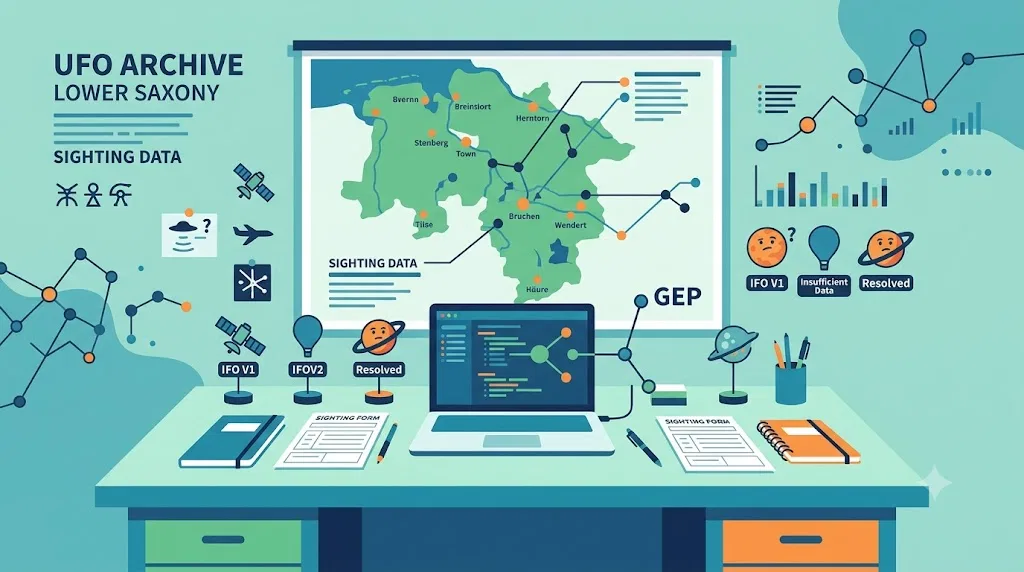
GEP records are useful for Lower Saxony because they turn scattered “strange lights” and “unknown objects” into checkable case material: dates, places, witness descriptions, preliminary sighting types, investigation outcomes and proposed explanations. The main pattern is not a hidden run of confirmed extraordinary craft. It is a more sober one: many Lower Saxony reports become ordinary explanations once timing, direction, astronomy, aircraft, balloons, lanterns, satellites, camera artefacts and weather are checked. A smaller number remain unresolved, but often because the data is thin rather than because the evidence is strong. The value of the GEP material is therefore diagnostic. It shows how uncertainty is produced, reduced, archived and sometimes left open in a state with busy skies, rural viewing conditions, military and aviation connections, and repeated media interest in unusual lights. The GEP’s own dataset describes its records as UFO/UAP reports containing case number, date and time, location, report route, free-text account, classifications and investigation results, with personal data removed for privacy.[Zenodo]zenodo.orgOpen source on zenodo.org.
What the GEP Records Contain
The Gesellschaft zur Erforschung des UFO-Phänomens, usually shortened to GEP, is a civilian German UFO/UAP research organisation rather than a government agency. Its records matter because they provide one of the longest-running German attempts to document reports in a structured way. GEP says it has investigated more than 5,500 UAP reports, while its public Zenodo release makes a large portion of the case data available as a downloadable dataset; the July 2025 version covers 1972 to June 2025 and contains fields such as location, date, classification and identification group.[UFO Research]ufo-research.orgOpen source on ufo-research.org.
For Lower Saxony, this means the state can be studied through a series of small, comparable entries rather than only through memorable newspaper stories. A typical record may say that someone in Braunschweig saw a bright object, that someone in Hildesheim photographed something unusual near the Moon, or that a witness in Osterode saw a dramatic spiral-like light. Those entries can then be compared with the final identification field: balloon, aircraft, satellite, lens reflection, atmospheric effect, drone, insufficient data, or no identification.
The records also preserve the route by which cases entered the archive. Some reports came through email, phone calls, a questionnaire, a database form, Facebook or the GEP forum. That detail matters because UFO archives are not neutral recordings of every odd thing in the sky. They are shaped by how easy it is to report, what media stories are circulating, what people photograph with phones, and which groups are known to the public at the time. A surge in reports can therefore reflect a real sky event, a popular consumer object, a reporting channel, a news cycle, or all of these together.
GEP’s method uses several layers of classification. Hynek categories such as night lights, daylight discs and close encounters are used to describe the reported sighting type before the investigation. Hendry-style categories are used after investigation to separate identified objects, insufficient-data cases, hoaxes, psychologically framed cases and more anomalous unresolved reports. GEP also uses an IFO verification scale: V1 for strong time-and-place coincidence with a known object, V2 for a good match to known object characteristics, and V3 where several ordinary explanations remain plausible.[UFO Forschung]ufo-forschung.deOpen source on ufo-forschung.de.
That structure is helpful, but it also means readers should not treat a case label as a verdict of equal strength in every entry. A “night light” is not a claim about alien origin; it is a sighting type. An “IFO V2” is not as strong as a direct V1 match. “Insufficient data” is not a dramatic mystery; it usually means the available information is too weak to test properly.
What Lower Saxony Patterns Look Like in the Archive
The strongest Lower Saxony pattern in the GEP material is repetition of ordinary sky stimuli under conditions that make them look strange. The same broad classes appear again and again: orange lights around celebrations, bright planets or stars filmed on phones, aircraft seen from unfamiliar angles, balloons seen in daylight, satellites moving in lines or producing odd light effects, and camera artefacts noticed only after a photograph is enlarged.
One clear example is the 2008 lantern period. Regional reporting described Hannover as a temporary “UFO capital”, with ten sightings from the city by early August 2008 and other Lower Saxony places such as Peine and Wolfsburg also mentioned in connection with reports. The explanation offered by Werner Walter of the Mannheim UFO reporting scene was not a single extraordinary craft but the popularity of sky lanterns, which had produced hundreds of calls and emails after becoming common party objects.[Braunschweiger Zeitung]braunschweiger-zeitung.deBraunschweiger Zeitung Hannover ist Ufo-HauptstadtBraunschweiger Zeitung Hannover ist Ufo-Hauptstadt
The GEP dataset shows the same kind of pattern in concrete Lower Saxony entries. On 7 June 2008, cases from Hannover-Vahrenwald, Gifhorn, Wunstorf and Seevetal-Maschen were recorded, with several classified as model hot-air balloons or similar lantern-type objects; the Seevetal case, which sounded more elaborate in witness language, was instead attributed to a lighting-effect device. Around the same period, records from Oldenburg, Hemmingen, Lindern and Goslar were also linked to model hot-air balloons or sky lantern-type explanations.[Zenodo]zenodo.orgUFO UAP Falldaten GEP 1972 2025.06.csvUFO UAP Falldaten GEP 1972 2025.06.csv
That matters because it shows how a “flap” can be built from many sincere observations of a new or newly fashionable object. A witness sees a silent orange or yellow light, often moving slowly and fading out. Several people report similar things over several nights. Local media notice a cluster. The pattern feels meaningful. Yet the archive points towards a social and technical cause: consumer lanterns entering ordinary night skies at scale.
A later pattern is satellite confusion. In January 2020, a Lower Saxony report from Riede described around 20 objects moving like a string of pearls across the sky; GEP identified the case as SpaceX Starlink satellites. In March 2025, the Osterode am Harz entry described a rotating “spiral galaxy” apparently rushing towards Earth; GEP classified it as a satellite-related engine burn or fuel-release effect.[Zenodo]zenodo.orgUFO UAP Falldaten GEP 1972 2023.csvUFO UAP Falldaten GEP 1972 2023.csv
These examples are important because they update older UFO explanations. In the 1990s and 2000s, investigators often looked first at aircraft, Venus, meteors, balloons and lanterns. In the 2020s, satellite trains, rocket exhaust effects and drone-like lights have become central to interpretation. The archive does not make Lower Saxony less interesting; it makes the state a useful record of how ordinary explanations change with technology.
How Classifications Can Mislead Readers
The biggest trap in reading GEP records is assuming that “unidentified” means “well-evidenced anomaly”. It does not. GEP’s own classification guidance separates unresolved cases by quality and strangeness, and says that only cases classed as GOOD or BEST UFO should be taken into wider national or international discussion. It also notes criticism of older classification systems, including the problem that “strangeness” has not always been clearly defined.[UFO Forschung]ufo-forschung.deOpen source on ufo-forschung.de.
That distinction is essential for Lower Saxony. The dataset contains cases that sound impressive in witness language but are later identified. A 2025 Braunschweig case involved a bright, silent object without obvious wings, rotors or structure; it remained unclassified in the visible entry at that stage. Another Braunschweig case from April 2025, reported via German air-traffic channels, was identified by GEP as a foil balloon. A Hildesheim case from March 2025 involved greenish objects found in iPhone photos near the Moon and Jupiter; GEP classified it as lens reflection.[Zenodo]zenodo.orgUFO UAP Falldaten GEP 1972 2025.06.csvUFO UAP Falldaten GEP 1972 2025.06.csv
The reader-facing lesson is simple: witness confidence, dramatic description and photographic material do not automatically strengthen a case. Photographs often introduce new problems: reflections, insects, birds, particles, motion blur, compression, zoom artefacts and phone processing effects. A photograph can be evidence, but it can also be the source of the mystery.
The GEP record for Salzgitter-Watenstedt in June 2025 is a good example of an unresolved-looking report that should still be read cautiously. A witness described a dark, saucer-like cloud with a white stripe, moving step by step and appearing unlike normal cloud behaviour. In the dataset excerpt, the case appears as a daylight-disc type without a final identification shown in the visible fields. That does not make it strong evidence for a craft; it means the public entry, at that point, did not show a completed ordinary identification.[Zenodo]zenodo.orgUFO UAP Falldaten GEP 1972 2025.06.csvUFO UAP Falldaten GEP 1972 2025.06.csv
The same caution applies to older entries with missing dates or retrospective memories. A record from Munster, reported in 2009 but referring to an event around 1995, described a star-like light moving back and forth before disappearing. Another from Emden, reported in 2008, described a light that stopped and changed direction sharply. Both are interesting as witness accounts, but the classification shown is “insufficient data”. That is a weak evidential category, not a high-status mystery.[Zenodo]zenodo.orgUFO UAP Falldaten GEP 1972 2025.06.csvUFO UAP Falldaten GEP 1972 2025.06.csv
Why Weak Data Is Not Strong Evidence
UFO archives are most useful when they preserve uncertainty honestly. The GEP’s own research writing is unusually frank about this. A 2023 paper by GEP-linked authors says the organisation received roughly one report per day in 2023, gathers standardised information, checks secondary data such as geography, weather and astronomical constellations, and aims for an explanatory hypothesis with a fairly high probability. It also states that around 5% of reported cases remain unexplained.[ResearchGate]researchgate.netOpen source on researchgate.net.
That 5% figure is often where misunderstanding begins. A leftover category after investigation is not a basket of proven extraordinary objects. It can include cases where the witness account is too brief, the direction is unclear, the timing is imprecise, the photo is missing, the object was seen for only seconds, or the report was made years later. GEP’s research paper explicitly discusses limits in visual perception, memory and witness statements, and notes that reliability and comparability become harder as a case becomes stranger.[ResearchGate]researchgate.netOpen source on researchgate.net.
Lower Saxony illustrates that problem repeatedly. A report from Wilhelmshaven in June 2008 involved a claimed photograph, but the photo was not submitted for assessment; GEP marked it as insufficient data. An Esens case from September 2013 described a white light approaching an aircraft, briefly following it and changing course, but the entry was classified as insufficient data. A Stade entry from 2016 involved a star-like light that appeared to fall and dissolve; GEP’s favoured explanation was a drone, but only with a V3 level of verification.[Zenodo]zenodo.orgUFO UAP Falldaten GEP 1972 2025.06.csvUFO UAP Falldaten GEP 1972 2025.06.csv
These are not meaningless cases. They show the exact point where public curiosity meets investigative limits. A sincere witness can report something real, and the archive can still be unable to prove what it was. The honest conclusion is not “nothing happened” and not “something extraordinary happened”. It is: something was reported, but the available data does not carry the stronger claim.
This is where Lower Saxony’s case records are more valuable than a single famous incident would be. They teach readers to distinguish three different outcomes:<div class="content-enhancement content-enhancement--metric" markdown="1">
- Resolved cases: the report matches a known object or phenomenon closely enough to classify it as identified.
- Weak unresolved cases: the report remains open mainly because the evidence is incomplete, late, ambiguous or non-repeatable.
- Potentially stronger unresolved cases: the report has enough detail, multiple independent witnesses, good timing, clear direction, usable images or instrument data, and still resists ordinary explanation.</div>
Most public UFO debates blur those categories. The GEP archive helps keep them apart.
Lower Saxony’s Recurring Explanations
The Lower Saxony records show several recurring explanation families, each with its own tell-tale pattern.
Lanterns and small balloons often appear as silent orange, red or yellow lights that drift, fade, seem to stop, or move in groups. They were especially prominent in the 2008–09 period, including New Year and party-related cases. GEP entries from Hannover, Wunstorf, Gifhorn, Oldenburg, Hemmingen and Oyten-Bassen fit this pattern in the dataset.[Zenodo]zenodo.orgUFO UAP Falldaten GEP 1972 2025.06.csvUFO UAP Falldaten GEP 1972 2025.06.csv
Planets, stars and bright astronomical objects often appear when witnesses report a very bright point that seems to move, flicker, change colour, or behave oddly through phone zoom. The apparent movement may come from hand motion, atmospheric shimmer, lack of reference points or digital magnification. GEP’s classification guide matters here because a V1 astronomical identification is much stronger than a vague guess: it requires a time-and-place match with a known object.[UFO Forschung]ufo-forschung.deOpen source on ufo-forschung.de.
Aircraft and helicopters are common in a state where civilian and military aviation are part of the sky environment. Reports can sound strange when an aircraft is viewed head-on, partly obscured, low over the horizon, or heard after the light is seen. In 2025, the Ebergötzen-Holzerode entry described loud, unusual noise and three white, non-blinking lights on a low-flying object; GEP identified it as aircraft with V1 confidence.[Zenodo]zenodo.orgUFO UAP Falldaten GEP 1972 2025.06.csvUFO UAP Falldaten GEP 1972 2025.06.csv
Satellites and space activity have become increasingly important. Starlink trains produce “string of pearls” descriptions. Rocket or satellite-related fuel releases can produce spirals or expanding clouds that look far more exotic than ordinary aircraft. The Riede 2020 and Osterode 2025 entries show this newer Lower Saxony pattern clearly.[Zenodo]zenodo.orgUFO UAP Falldaten GEP 1972 2023.csvUFO UAP Falldaten GEP 1972 2023.csv
Camera and phone effects are particularly important in recent records. The object may not have been noticed during the original observation; it appears only after zooming, cropping or reviewing the image. The Hildesheim 2025 lens-reflection case and older Haverlah 2016 lens-reflection entry show how the archive separates a photographed anomaly from a physical object in the sky.[Zenodo]zenodo.orgUFO UAP Falldaten GEP 1972 2025.06.csvUFO UAP Falldaten GEP 1972 2025.06.csv
What the Records Reveal About Lower Saxony
The GEP records do not support a simple claim that Lower Saxony is a uniquely mysterious UFO hotspot. They show something more useful: Lower Saxony is a varied observation environment where many normal causes can look unusual. Coastal towns, rural darkness, car journeys, garden parties, urban lighting, aircraft routes, airfields, military associations and changing sky technology all create situations in which ordinary objects are misread.
Hannover’s 2008 “UFO capital” moment is the clearest public-facing example. It was memorable because it looked like a local cluster, but its most persuasive explanation was not local at all: the spread of sky lanterns as a popular object. The GEP entries from the same period show that Lower Saxony was part of a wider German reporting wave rather than the centre of a confirmed anomaly.[Braunschweiger Zeitung]braunschweiger-zeitung.deBraunschweiger Zeitung Hannover ist Ufo-HauptstadtBraunschweiger Zeitung Hannover ist Ufo-Hauptstadt
The 2020s entries show a different kind of pattern. Instead of lanterns dominating the story, the archive contains satellites, drones, balloons, phone artefacts and spectacular space-related light effects. That shift matters for any modern Lower Saxony UFO history. A reader looking only for “classic saucers” will miss the real archival lesson: the UFO category changes as the sky changes.
The unresolved cases still have value, but mainly as prompts for better evidence standards. A strong future Lower Saxony case would need precise time, direction, duration, angular movement, weather, independent witnesses, original image files, aircraft and satellite checks, and ideally corroborating sensor data. Without that, a case may remain personally meaningful to the witness while staying weak as public evidence.
How to Read the Archive Without Overreading It
The best way to use the GEP records is not to ask, “Which Lower Saxony cases prove UFOs are real?” A better question is, “Which reports survive ordinary checks, and why?” That changes the reading of the archive. Identified cases become just as important as unresolved ones because they reveal the mechanisms that generate UFO reports in the first place.
A cautious reader should look for four things. First, whether the sighting was reported promptly or years later. Second, whether the record has enough time-and-location detail to test against aircraft, satellites, planets and weather. Third, whether the final classification is strong, weak or simply absent. Fourth, whether the claimed strangeness remains after investigation or only appears in the first witness description.
This approach keeps Lower Saxony’s UFO history balanced. It does not dismiss witnesses as foolish; many reports are sincere, detailed and understandable. It also does not turn every gap into evidence for an extraordinary object. The GEP archive’s strongest contribution is that it shows both sides at once: people really do encounter puzzling things in the sky, and many of those puzzles become ordinary once they are put into a disciplined record.
Amazon book picks
Further Reading
Books and field guides related to What UFO Archives Reveal About Lower Saxony. Use these as the next step if you want deeper reading beyond the article.
The UFO Experience
Directly matches classification, investigation quality and the limits of case records.

UFOs : Generals, Pilots, and Government Officials Go on the R...
Focuses on documented reports, official testimony and the problem of unresolved cases.
UFOs and Government
Relevant to how institutions collect, classify and interpret UFO reports over time.
Factfulness
Helps readers understand why patterns in datasets can mislead without context and denominator awareness.
eBay marketplace picks
Marketplace Samples
Live-tested eBay searches with available results related to this page.



Endnotes
1.
Source: zenodo.org
Link:https://zenodo.org/records/15882235
2.
Source: zenodo.org
Title: UFO UAP Falldaten GEP 1972 2025.06.csv
Link:https://zenodo.org/records/15882235/files/UFO-UAP-Falldaten_GEP_1972-2025.06.csv?download=1
3.
Source: ufo-research.org
Link:https://www.ufo-research.org/
5.
Source: braunschweiger-zeitung.de
Title: Braunschweiger Zeitung Hannover ist Ufo-Hauptstadt
Link:https://www.braunschweiger-zeitung.de/archiv/article150468809/Hannover-ist-Ufo-Hauptstadt.html
6.
Source: zenodo.org
Title: UFO UAP Falldaten GEP 1972 2023.csv
Link:https://zenodo.org/records/10547073/files/UFO-UAP-Falldaten_GEP_1972-2023.csv?download=1
7.
Source: researchgate.net
Link:https://www.researchgate.net/publication/380530617_UAP_Research_in_Germany_Single_Case_Studies_Data_Management_Understanding_of_Strangeness
8.
Source: zenodo.org
Link:https://zenodo.org/records/10547073
9.
Source: zenodo.org
Link:https://zenodo.org/records/13923653
10.
Source: ufo-forschung.de
Link:https://www.ufo-forschung.de/author/gepweb
11.
Source: ufo-forschung.de
Link:https://www.ufo-forschung.de/publikationen
12.
Source: ufo-forschung.de
Title: neue gep sonderpublikation die ungeklaerten ufo faelle der gep
Link:https://www.ufo-forschung.de/forschung/neue-gep-sonderpublikation-die-ungeklaerten-ufo-faelle-der-gep
13.
Source: ufo-forschung.de
Title: gep untersuchte 5 000 ufo fall
Link:https://www.ufo-forschung.de/verein/gep-untersuchte-5-000-ufo-fall
14.
Source: ufo-forschung.de
Link:https://www.ufo-forschung.de/
15.
Source: ufo-forschung.de
Link:https://www.ufo-forschung.de/downloads
16.
Source: ufo-forschung.de
Link:https://www.ufo-forschung.de/ufo-sichtung-melden
18.
Source: gep.com
Title: the 2024 annual procurecon cpo report
Link:https://www.gep.com/research-reports/the-2024-annual-procurecon-cpo-report
19.
Source: gep.com
Title: gep outlook 2024
Link:https://www.gep.com/research-report/gep-outlook-2024
20.
Source: gep.com
Title: gep spend category outlook 2024
Link:https://www.gep.com/research-report/gep-spend-category-outlook-2024
21.
Source: facebook.com
Link:https://www.facebook.com/News13/posts/the-defense-department-has-released-new-ufo-files-of-sightings-in-the-northeaste/1309312774738786/
22.
Source: facebook.com
Link:https://www.facebook.com/NewsNationNow/posts/ufo-files-fbi-agents-investigating-uap-report-saw-one-themselves-ufo-fbi-newsnat/1024426066631077/
23.
Source: ufo-information.de
Link:https://ufo-information.de/index.php/ufoklassifikationen
24.
Source: hjkc.de
Title: UF O-Forschung
Link:https://www.hjkc.de/_blog/13895-ufo-forschung-aus-dem-cenap-archiv-ufo-history-teil-292/
25.
Source: trauer-lueneburg.de
Title: werner walter
Link:https://www.trauer-lueneburg.de/traueranzeige/werner-walter
Additional References
26.
Source: youtube.com
Link:http://www.youtube.com/watch?v=CLMlUaEPuXM
27.
Source: youtube.com
Title: Research on UAP, SETI and Space Technologies at Julius Maximilians University
Link:http://www.youtube.com/watch?v=MZZQ-9RkDgk
28.
Source: war.gov
Title: department of defense releases the annual report on unidentified anomalous phen
Link:https://www.war.gov/News/Releases/Release/Article/3964824/department-of-defense-releases-the-annual-report-on-unidentified-anomalous-phen/
29.
Source: gepgroup.gr
Link:https://www.gepgroup.gr/wp-content/uploads/2025/04/GEP_Annual-Report-2022-2023-1.pdf
30.
Source: deutsche-digitale-bibliothek.de
Link:https://www.deutsche-digitale-bibliothek.de/organization/gnd/2088807-7
31.
Source: verbandsforum.de
Link:https://www.verbandsforum.de/verbaende/buergerinteressen/hobby-und-freizeit/gesellschaft-zur-erforschung-des-ufo-phaenomens-ev%2C854%2Cde%2C1641%2C57430?from=120
32.
Source: openpr.de
Link:https://www.openpr.de/news/885351/Silvester-UFOs-gesehen-Happy-New-Year-2016-der-Alien-Harvest-zur-Silvesternacht-in-Hamburg-und-Pforzheim.html
33.
Source: amazon.de
Link:https://www.amazon.de/Ufos-Die-Wahrheit-Werner-Walter/dp/3442127726?tag=searcht-20
34.
Source: stern.de
Link:https://www.stern.de/panorama/wissen/kosmos/themen/werner-walter-4182706.html
35.
Source: eppo.europa.eu
Link:https://www.eppo.europa.eu/assets/annual-report-2024/pdfs/statistics-member-state/Germany.pdf
Topic Tree
Follow this branch
Parent topic
Lower Saxony UFOsRelated pages 11
- Algermissen The UFO Alarm That Became a Human Case
- Drones When UFO Reports Become Drone Incidents
- Goslar Photos When UFOs Appear Only in Photographs
- Hannover Flap Why Hannover Became a UFO Capital
- Planets When the Night Sky Looks Like a UFO
- Police Reports What Police Records Do and Do Not Prove
- Press Framing How Headlines Turn Lights Into UFO Stories
- Sky Lanterns Why Orange Lights Often Become UFOs
- +3 more in sidebar