Within Bavaria UFOs
How Much Can One Broadsheet Prove?
Glaser's image is a key source, but it blends news, spectacle and religious warning rather than modern investigation.
On this page
- The source and its setting
- Image, text and interpretation
- Limits of using it as evidence
Page outline Jump by section
Introduction
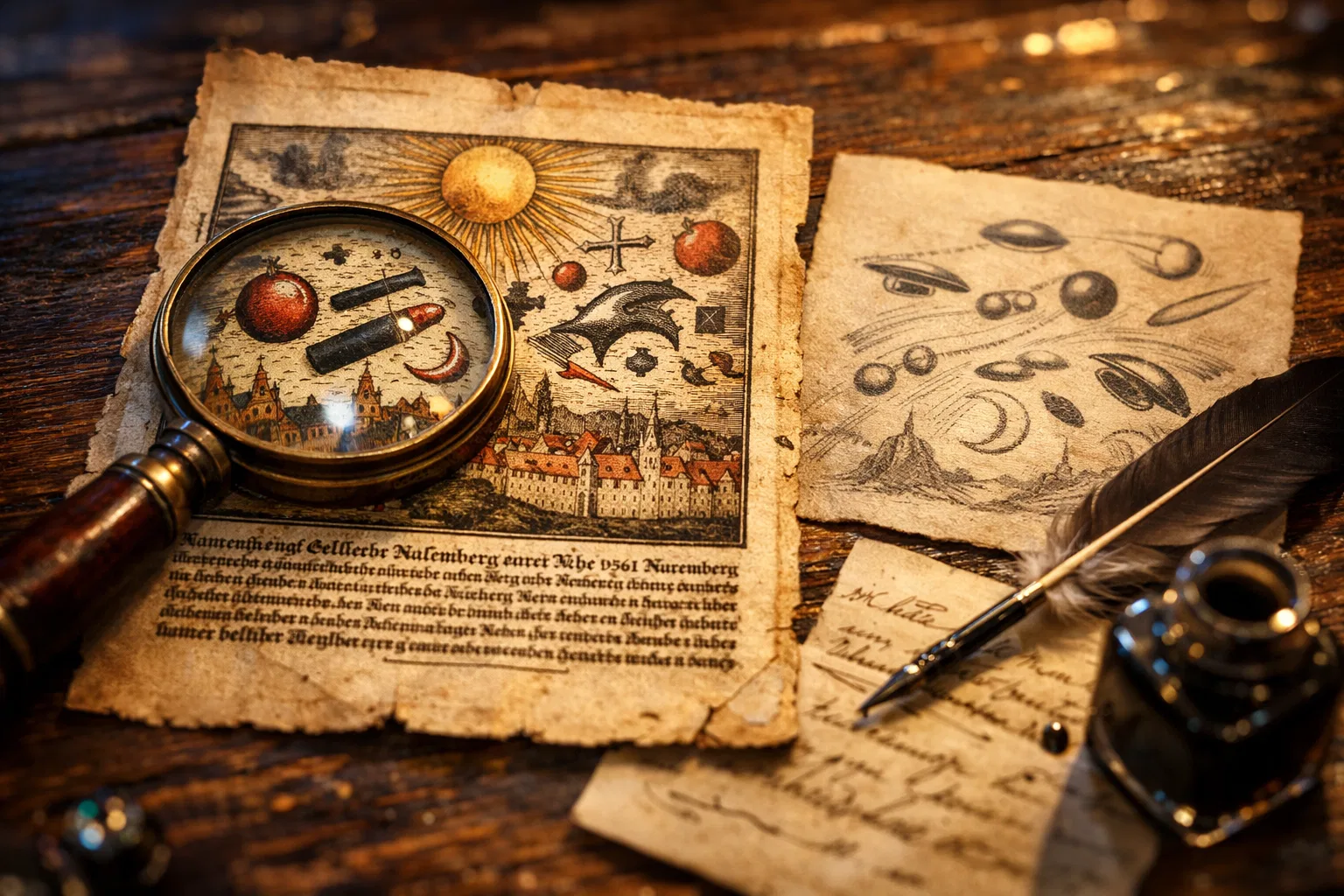
Hans Glaser’s 1561 broadsheet is one of the most famous early sources used in modern UFO retellings of Bavaria, but it is not strong evidence in the way a modern investigation would use that word. It is a printed image and text made in Nuremberg after a reported dawn sky spectacle on 14 April 1561, showing globes, rods, crosses, crescents and dark forms apparently fighting around the sun. Its value is real, but limited: it proves that a striking story was printed and circulated in a now-Bavarian city, not that machines or craft were seen over the city. The broadsheet matters because it sits exactly where many older UFO claims become difficult: between witness report, popular art, religious warning, news-sheet spectacle and later reinterpretation.[The Public Domain Review]publicdomainreview.orgcelestial phenomenon over nuremberg april 14th 1561The Public Domain ReviewCelestial Phenomenon Over Nuremberg, April 14th, 156114 Apr 2016 — A woodcut and description of strange UFOs seen…
For Bavaria’s UFO history, the Glaser source is best treated as a founding caution rather than a solved case. Nuremberg is now part of Bavaria, although in 1561 it was a Free Imperial City of the Holy Roman Empire, so the case belongs to the Bavarian branch through modern geography and regional UFO memory rather than through any Bavarian state record.[Wikipedia]WikipediaOpen source on wikipedia.org.
The source and its setting
The object at the centre of the story is not a government file, a diary entry, a set of sworn depositions or a chain of independent witness statements. It is a broadsheet: a single printed sheet combining text and a woodcut image for public circulation. Public Domain Review identifies the surviving source as Glaser’s illustrated account of a “celestial phenomenon” over Nuremberg, produced later in April 1561 after the reported event. The image is preserved through the Zentralbibliothek Zürich / e-manuscripta tradition and is now widely reproduced in UFO books, websites and public-domain image archives.[The Public Domain Review]publicdomainreview.orgcelestial phenomenon over nuremberg april 14th 1561The Public Domain ReviewCelestial Phenomenon Over Nuremberg, April 14th, 156114 Apr 2016 — A woodcut and description of strange UFOs seen…
That format matters. In the sixteenth-century German-speaking world, broadsheets often reported startling events as signs, wonders and warnings. They mixed information, moral instruction and vivid imagery. Public Domain Review’s wider collection on German celestial phenomena notes that printed sheets in the Holy Roman Empire covered anomalies in the sun, moon and stars, falling stones and fire, unusual rainbows, “rains of blood” and other wonder-signs. These were not neutral scientific reports. They were made for readers who often understood strange events in the sky as morally charged messages about repentance, judgement or political and religious crisis.[The Public Domain Review]publicdomainreview.orgcelestial phenomena 16th century germanyThe Public Domain ReviewSigns and Wonders: Celestial Phenomena in 16th-Century…11 Apr 2024 — German broadsheets in the Holy Roman Empi…
The 1561 Nuremberg sheet fits that world. Its wording places the spectacle at daybreak, between about four and five in the morning, and describes it as happening on or around the sun. The report says many people in and around the city saw frightening forms: blood-red arcs, balls, rods and crosses, followed by a struggle lasting more than an hour and then the fall of objects beyond the city. The details are memorable, but they come to us through Glaser’s printed shaping of the episode, not through a modern evidence bundle.[The Public Domain Review]publicdomainreview.orgcelestial phenomenon over nuremberg april 14th 1561The Public Domain ReviewCelestial Phenomenon Over Nuremberg, April 14th, 156114 Apr 2016 — A woodcut and description of strange UFOs seen…
Hans Glaser himself was a local printmaker and publisher, not an aviation investigator, astronomer or official recorder of unexplained aerial reports. Biographical summaries describe him as a Nuremberg printer, block-cutter, woodcut tinter and publisher active in the mid-sixteenth century, known for illustrated broadsheets. That does not make him unreliable by default, but it does define the nature of the source: he was producing a saleable, interpretable printed artefact in a culture that valued dramatic visual reporting.[Wikipedia]WikipediaHans GlaserHans Glaser
What the image appears to show
Glaser’s woodcut is the reason the case still travels so easily. The scene is visually direct in a way the text is not: a recognisable city below, a large sun above, and a sky crowded with geometric forms. Modern viewers quickly notice shapes that look, to contemporary eyes, like spheres, tubes, discs, beams or craft. That resemblance is the bridge by which the Nuremberg sheet entered UFO culture.
The difficulty is that the image is not a photograph, diagram or timed observational sketch. It is a symbolic, compressed woodcut. The objects are arranged for impact and legibility. Their colours and shapes make the sky readable as conflict. The “battle” is not merely a neutral description of motion; it is a visual and moral frame. In sixteenth-century print culture, crosses, blood-red forms and fighting bodies in the heavens could communicate divine warning as much as physical observation.[The Public Domain Review]publicdomainreview.orgcelestial phenomena 16th century germanyThe Public Domain ReviewSigns and Wonders: Celestial Phenomena in 16th-Century…11 Apr 2024 — German broadsheets in the Holy Roman Empi…
Several parts of the image are especially important for interpretation:
The sun is central. The event is described as occurring at dawn and in relation to the sun. That places atmospheric optics near the top of any cautious explanation, because low sun angles can produce striking halo effects.
The shapes are mixed. The sheet does not describe one consistent object type. It shows and names many forms: globes, rods, crosses, arcs and dark shapes. This variety weakens simple “one object” readings.
The scene is moralised. The text does not simply ask what was in the sky. It presents the spectacle as frightening and meaningful, in line with printed wonder literature.
The city view is part of the message. Nuremberg is not just a location marker; it is the audience’s world placed beneath a warning sky.
This makes the broadsheet powerful art, but awkward evidence. It may preserve a real reported sighting. It may preserve a natural phenomenon transformed by collective interpretation. It may combine observation, rumour, convention and moral commentary. It cannot, on its own, separate those layers cleanly.
Why it became a UFO source
The Nuremberg broadsheet became famous in modern UFO culture partly because it looks surprisingly technological to modern eyes. Cylinders with smaller round forms emerging from them can look like launch tubes or carriers. Dark spear-like forms can look like craft. A sky full of battling shapes can be read as an aerial engagement. Once modern readers bring the vocabulary of “UFO battle”, “spacecraft” or “ancient aliens” to the image, the woodcut seems to anticipate it.
That is a classic problem in historical UFO interpretation: later categories can make older sources look more precise than they are. The word “UFO” means an unidentified flying object, not automatically an alien craft. In a sixteenth-century broadsheet, the issue is even trickier, because the categories available to the original maker and audience were not aviation, radar, spaceflight or extraterrestrial visitation. They were signs, portents, divine warnings, marvels, natural philosophy and printed news.[The Public Domain Review]publicdomainreview.orgcelestial phenomena 16th century germanyThe Public Domain ReviewSigns and Wonders: Celestial Phenomena in 16th-Century…11 Apr 2024 — German broadsheets in the Holy Roman Empi…
The broadsheet’s twentieth-century afterlife also matters. Public Domain Review notes that the Nuremberg image largely faded from wider attention until it appeared in Carl Jung’s 1958 work on flying saucers as a modern myth. Jung’s interest was not simply whether physical objects flew over Nuremberg; he was concerned with the symbolic and psychological force of UFO images. That helped place Glaser’s print inside the modern conversation about sightings, archetypes and the meaning people project onto the sky.[The Public Domain Review]publicdomainreview.orgcelestial phenomenon over nuremberg april 14th 1561The Public Domain ReviewCelestial Phenomenon Over Nuremberg, April 14th, 156114 Apr 2016 — A woodcut and description of strange UFOs seen…
From there, the image became easy to detach from its original setting. Online retellings often reproduce the woodcut as if it were a near-modern eyewitness illustration. More careful readings keep the original medium in view: a broadsheet made for a Reformation-era audience, reporting a frightening dawn spectacle in the language of warning.
The best evidence it provides
The strongest thing Glaser’s broadsheet proves is cultural, not extraterrestrial. It shows that in April 1561 a Nuremberg printer published a striking account of a sky event said to have been seen by many people. It also shows that the event was considered meaningful enough to turn into a public image and text. That is not nothing. For a state-level UFO history of Bavaria, it gives the region one of Europe’s most recognisable pre-modern sky-spectacle sources.
As evidence, the broadsheet is useful in three main ways.
First, it preserves a date, place and narrative. The reported event is tied to Nuremberg, dawn on 14 April 1561, and a spectacle involving forms around the sun. That gives the story a concrete anchor rather than a vague legend.
Second, it preserves how the event was framed for contemporary readers. The image does not merely record shapes; it turns the sky into a scene of conflict and warning. That helps modern readers understand why the story survived: it was dramatic, moral and memorable.
Third, it demonstrates the long history of ambiguous sky reports being reinterpreted. The same source can be read as a divine sign, an atmospheric display, a psychological symbol, a printed sensation or a UFO case. That interpretive flexibility is exactly why early sources must be handled carefully in UFO history.
The broadsheet is therefore evidence of a reported and culturally processed sky spectacle. It is not, by itself, evidence of structured craft, non-human technology or a literal aerial battle.
Why a natural explanation remains plausible
A cautious reading starts with the sun. The reported spectacle happened at dawn, and the text places the apparition in close relation to the sun. Sun dogs and related halo phenomena are caused by sunlight interacting with ice crystals in high cloud. The Met Office explains that parhelia, or sun dogs, result from sunlight passing through hexagonal ice crystals in cirrus cloud and often appear with 22-degree halos. The Hong Kong Observatory similarly notes that sun dogs occur when the sun is at a low elevation angle, especially near sunrise or sunset.[Met Office]weather.metoffice.gov.ukOpen source on metoffice.gov.uk.
That does not mean “sun dog” explains every line of Glaser’s account. It probably does not. The broadsheet contains too many dramatic, symbolic and possibly embellished details to map neatly onto one modern meteorological label. But a dawn solar optical effect is a stronger starting point than spacecraft because it fits the most basic conditions: low sun, bright coloured forms near the sun, and a spectacle that could be frightening to observers without modern atmospheric optics.
The wider pattern also supports caution. Similar early modern sky prints from German-speaking Europe and nearby regions often described celestial signs in martial or religious language. The Swiss National Museum’s discussion of the 1566 Basel event compares it with the Nuremberg leaflet and other printed sky phenomena, noting that such works used militaristic symbolism and framed celestial manifestations through war, civil conflict or political change.[Swiss History Blog]blog.nationalmuseum.chthe celestial event over basel in 1566the celestial event over basel in 1566
This matters because “battle” may describe interpretation as much as observation. When people see unfamiliar lights, colours, arcs or patches moving in relation to the sun and clouds, a culture already trained to see heavenly warnings may narrate the event as combat. The printed woodcut then reinforces that reading for later audiences.
The warning hidden in the source
The Glaser broadsheet is often discussed because of its image, but its warning function is just as important. Early modern wonder literature did not usually treat strange skies as neutral curiosities. It asked what they meant. A frightening sky could be taken as a call to repentance, a sign of divine displeasure, or a warning of disorder. Public Domain Review’s wider account of sixteenth-century celestial broadsheets connects these reports with belief in wonder-signs and Last Judgement expectation, while research on late Reformation Germany notes that clergy and writers used celestial signs such as comets, unusual solar events and strange objects to support religious and social agendas.[The Public Domain Review]publicdomainreview.orgcelestial phenomena 16th century germanyThe Public Domain ReviewSigns and Wonders: Celestial Phenomena in 16th-Century…11 Apr 2024 — German broadsheets in the Holy Roman Empi…
That warning layer changes how the Nuremberg sheet should be read. Glaser was not simply saying, “Here are unexplained objects.” He was presenting a frightening spectacle within a moral universe. The strange sky mattered because it could be read as a message. The image’s blood-red forms, crosses and apparent conflict are not incidental decorations; they are part of the sheet’s persuasive force.
For modern UFO readers, this is the key difference between a source and an investigation. A modern investigation tries to reduce interpretation: what was seen, where, by whom, for how long, under what conditions, with what independent corroboration? Glaser’s broadsheet increases interpretation. It turns a reported sky event into a public lesson.
That does not make it worthless. It makes it historically rich. The warning is part of the evidence, because it tells us what kind of document this was and what kind of reaction it was designed to provoke.
Limits of using it as evidence
The main weakness of the broadsheet is that it gives us no clean route back to the original observation. We do not have named witnesses with separate accounts. We do not have a measured sky position, weather record, astronomical analysis from the day, or independent official inquiry. We have a later printed representation shaped by a local producer working in a genre that rewarded vividness.
There are also visual and contextual problems. Sceptical discussions have pointed out that the cityscape is not a dependable literal record of Nuremberg as seen from a precise vantage point. The woodcut’s purpose was not topographical accuracy. If the city below is partly conventionalised, the sky above may be too. That is important because some UFO interpretations treat every shape as if it were a carefully observed object.[Wikipedia]Wikipedia1561 celestial phenomenon over Nuremberg1561 celestial phenomenon over Nuremberg
The source also compresses time and movement into one image. A phenomenon said to last more than an hour is shown as a single dramatic scene. That is normal for art, but it is not how observational data works. The print cannot tell us whether viewers saw many objects at once, successive stages of one optical effect, clouds changing around the sun, falling material, smoke from the ground, or a story elaborated after the fact.
Finally, translation and retelling add further layers. Many English-language versions rely on modern translations and summaries. Every retelling risks making the account sound more like a contemporary UFO report than a sixteenth-century religious broadsheet. The more a version strips away Glaser’s warning language, the more misleadingly modern the case can appear.
How much can one broadsheet prove?
One broadsheet can prove that a story existed, circulated and mattered. It can preserve local memory. It can show how a community or publisher made sense of a frightening sky. It can become a landmark in the later history of UFO interpretation. Glaser’s 1561 sheet does all of that.
It cannot prove that Nuremberg saw alien craft, advanced machines or a literal battle above the city. The evidence is too mediated, too symbolic and too dependent on one printed artefact. A responsible assessment should therefore place the case in the category of historically important but evidentially weak as a modern UFO claim.
That judgement does not make the Nuremberg broadsheet boring. It makes it more useful. It shows why Bavaria’s UFO history cannot be built only from dramatic images. The most famous picture in the regional tradition is also a warning about pictures: they can preserve evidence, shape belief and invite over-reading at the same time. For readers moving from the Nuremberg spectacle to later Bavarian cases involving military reporting, Project Blue Book files, pilot testimony or modern UAP data collection, Glaser’s sheet establishes the central lesson early: the first question is not “what does it look like to us now?”, but “what kind of source is this, and what can it actually bear?”
Amazon book picks
Further Reading
Books and field guides related to How Much Can One Broadsheet Prove?. Use these as the next step if you want deeper reading beyond the article.

Passport to Magonia: from folklore to flying saucers
Explores historical anomalous sky narratives.
eBay marketplace picks
Marketplace Samples
Live-tested eBay searches with available results related to this page.

Endnotes
1.
Source: Wikipedia
Link:https://en.wikipedia.org/wiki/Nuremberg
2.
Source: Wikipedia
Title: Hans Glaser
Link:https://en.wikipedia.org/wiki/Hans_Glaser
3.
Source: Wikipedia
Title: 1561 celestial phenomenon over Nuremberg
Link:https://en.wikipedia.org/wiki/1561_celestial_phenomenon_over_Nuremberg
4.
Source: Wikipedia
Link:https://en.wikipedia.org/wiki/Ufology
5.
Source: Wikipedia
Title: Nuremberg (2025 film)
Link:https://en.wikipedia.org/wiki/Nuremberg_%282025_film%29
6.
Source: Wikipedia
Title: Nürnberger Flugblatt von 1561
Link:https://de.wikipedia.org/wiki/N%C3%BCrnberger_Flugblatt_von_1561
7.
Source: Wikipedia
Title: Sun dog
Link:https://en.wikipedia.org/wiki/Sun_dog
8.
Source: medium.com
Title: the nuremberg ufo sighting of 1561 4078ecfcd946
Link:https://medium.com/lessons-from-history/the-nuremberg-ufo-sighting-of-1561-4078ecfcd946
9.
Source: medium.com
Link:https://medium.com/%40zzzyzzyva/celestial-battles-over-europe-were-16th-century-ufo-sightings-warnings-from-the-stars-cf22abd71e18
10.
Source: weather.gov
Link:https://www.weather.gov/arx/why_halos_sundogs_pillars
11.
Source: germany.travel
Title: Visit Nuremberg
Link:https://www.germany.travel/en/cities-culture/nuremberg.html
12.
Source: publicdomainreview.org
Title: celestial phenomenon over nuremberg april 14th 1561
Link:https://publicdomainreview.org/collection/celestial-phenomenon-over-nuremberg-april-14th-1561/
13.
Source: publicdomainreview.org
Title: celestial phenomena 16th century germany
Link:https://publicdomainreview.org/collection/celestial-phenomena-16th-century-germany/
15.
Source: blog.nationalmuseum.ch
Title: the celestial event over basel in 1566
Link:https://blog.nationalmuseum.ch/en/2024/07/the-celestial-event-over-basel-in-1566/
16.
Source: weather.metoffice.gov.uk
Link:https://weather.metoffice.gov.uk/learn-about/weather/optical-effects
17.
Source: weather.gov.hk
Title: 00353 indepth anatomy of the atmospheric optical phenomenon sun dog
Link:https://www.weather.gov.hk/en/education/earth-science/optical-phenomena/00353-indepth-anatomy-of-the-atmospheric-optical-phenomenon-sun-dog.html
18.
Source: reddit.com
Title: 1561 celestial phenomenon over nuremberg
Link:https://www.reddit.com/r/UFOs/comments/1fgveo2/1561_celestial_phenomenon_over_nuremberg/
19.
Source: oikofuge.com
Title: sun dogs
Link:https://oikofuge.com/sun-dogs/
Additional References
20.
Source: youtube.com
Title: The Nuremberg Celestial Phenomenon – Real 16th-Century Witness Accounts
Link:https://www.youtube.com/watch?v=dPyJDQizxeQ
21.
Source: youtube.com
Link:https://www.youtube.com/watch?v=fixLR5EgmJs
22.
Source: youtube.com
Link:https://www.youtube.com/watch?v=rX0189Ky9G0
23.
Source: youtube.com
Link:https://www.youtube.com/watch?v=kizUAAkRfLk
24.
Source: instagram.com
Link:https://www.instagram.com/p/DWSEE9eD8ID/
25.
Source: pdimagearchive.org
Link:https://pdimagearchive.org/images/b3bc53c4-226b-43b0-822d-5de7f931d816
26.
Source: instagram.com
Link:https://www.instagram.com/p/DUGWkuGEttw/?hl=en
27.
Source: facebook.com
Link:https://www.facebook.com/KelseyMcEwenTV/posts/did-you-get-treated-to-this-beautiful-view-of-the-sky-this-morning-sun-dogs-cold/1295744922366917/
28.
Source: e-rara.ch
Link:https://www.e-rara.ch/download/pdf/30642727.pdf
29.
Source: facebook.com
Link:https://www.facebook.com/PublicDomainReview/posts/image-from-a-16th-century-broadsheet-telling-of-a-celestial-apparition-which-occ/1072102888280415/
Topic Tree
Follow this branch
Parent topic
Bavaria UFOsRelated pages 11
- 1948 Memo Why Did Bavaria Start Logging Flying Discs?
- Cold War Skies When Strange Lights Became Security Questions
- Modern Skies What People Most Often Mistake for UFOs
- Mundane Causes Why Ordinary Objects Look Extraordinary
- Munich File What Did Project Blue Book Make of Munich?
- Nuremberg 1561 Was Nuremberg's Sky Battle Really a UFO?
- Phone Clips Why More UFO Videos Do Not Mean Better Evidence
- Pilot Witnesses Are Pilot UAP Reports More Reliable?
- +3 more in sidebar