Within Saxony Anhalt UFOs
When a Fireball Becomes a UFO Report
Fireballs offer a powerful explanation for some dramatic sightings because they can look sudden, bright and strange without being artificial craft.
On this page
- Why meteors can look extraordinary
- How fireball records help investigators
- Where the Halle case fits the pattern
Page outline Jump by section
Introduction
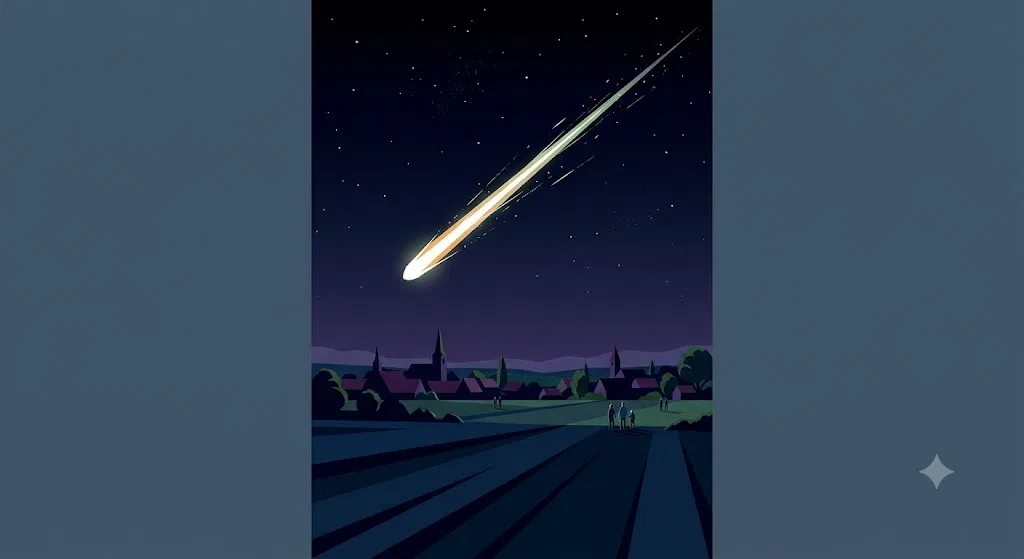
Fireballs and meteors are one of the most important natural explanations for UFO reports in Saxony-Anhalt because they can be sudden, bright, silent or explosive, and genuinely startling. A witness may see a white or green light crossing the sky, a glowing trail, a flash, fragmentation, or even hear a delayed boom, and reasonably describe it as an unidentified object before any astronomical checks have been made. In the state’s UFO history, the clearest example is the Halle sighting of 3 February 1985: several police employees reported unusual lights or objects over the city, but later reporting pointed to one or two meteorites seen travelling south to north shortly before midnight. The point is not that every Saxony-Anhalt UFO report is a meteor. It is that a short, dramatic fireball can create exactly the kind of sincere, high-confidence witness testimony that later turns out to have a natural origin.[mdr.de]mdr.deufo sichtung halle stasi thueringen 100Eine UFO-Sichtung in der DDR in CIA-Dokumenten; Im Osten immer noch weniger UFO-Sichtungen…Read more…
Why Meteors Can Look Extraordinary
A meteor is the visible streak produced when a small body from space enters the atmosphere at high speed and burns or fragments. A fireball is simply a very bright meteor, usually brighter than Venus; a bolide is often used for a fireball that ends in a bright flash or fragmentation. That definition matters for UFO reports because the threshold is not faint “shooting star” territory. A true fireball can dominate the sky for a few seconds, cast attention-grabbing light, leave a trail, break apart into fragments and appear far larger or closer than it really is.[amsmeteors.org]amsmeteors.orgOpen source on amsmeteors.org.
For an unprepared observer, several features can make a meteor feel artificial. It may appear to travel horizontally rather than “fall” downwards, especially if the path is long and seen at a shallow angle. It may change colour as different materials glow and as the light passes through the atmosphere. It may split into several pieces, creating the impression of formation lights or a craft breaking apart. If a sonic boom is heard later, the delay can also confuse the witness, because the sound reaches the ground after the visible event has already ended. ESA’s account of the 8 March 2026 western European fireball shows the same pattern on a modern, well-recorded scale: a very bright object was seen across several countries, glowed for about six seconds, left a visible trail, fragmented, and was reported as audible by some observers.[European Space Agency]esa.intESA analysing fireball over Europe on 8 March 2026ESA analysing fireball over Europe on 8 March 2026
The short duration is crucial. Many UFO reports involving hovering, repeated manoeuvres, long observation times or apparent interaction with aircraft do not fit a simple meteor explanation. But reports of a single fast light, a streak, an object that “burst”, or a brilliant body crossing the sky for seconds should always be checked against fireball records. In practice, the meteor explanation is strongest when many observers in different places report the same short event at nearly the same time, with a consistent broad direction of travel.
How Fireball Records Help Investigators
Modern fireball investigation is far better than guesswork. Organisations such as the International Meteor Organization and the American Meteor Society collect public reports through structured forms, asking where the witness was, when the event occurred, how long it lasted, how bright it looked, what direction it moved, and whether it fragmented or made sound. These details allow separate witness accounts to be grouped into a single event and compared with camera-network data when available.[fireballs.imo.net]fireballs.imo.netReport a FireballReport a Fireball
Camera networks add a second layer. The Global Meteor Network describes itself as a network of cameras pointed at the night sky, using low-cost video systems to detect meteors; its scientific papers describe how multiple camera stations can calculate a meteor’s path, speed and orbit rather than relying only on impressions from the ground. Ufokarte, an independent German mapping portal, uses GEP UFO/UAP case data alongside Global Meteor Network fireball data, which makes the comparison especially useful for a state-level UFO history page: the same map can show both reported UFO cases and recorded fireballs.[globalmeteornetwork.org]globalmeteornetwork.orgOpen source on globalmeteornetwork.org.
This does not mean a missing fireball entry proves that a sighting was not a meteor. Coverage is incomplete, weather matters, cameras do not see every part of the sky, and not every witness files a report. Ufokarte’s own Saxony-Anhalt case pages often include the caution that no nearby Global Meteor Network fireball is documented for a given night, but that this does not rule out a meteor. That is a healthy investigative standard: fireball records can strongly support an explanation, but absence from a database is not a magic disproof.[Ufokarte.de]ufokarte.deOpen source on ufokarte.de.
The strongest meteor identifications usually combine four things: a precise time, a short duration, multiple geographically separated witnesses, and a matching trajectory in a meteor or fireball database. A single vague memory from years later is much weaker. A same-night report with location, direction, duration and brightness is far more useful.
Where the Halle Case Fits the Pattern
The Halle case on 3 February 1985 is the key Saxony-Anhalt example because it shows both why fireballs become UFO reports and why later investigation can reduce the mystery without dismissing the witnesses. According to MDR’s historical account, five employees of the East German police independently observed unusual aerial phenomena over Halle between about 23:40 and midnight, from four different locations. Their descriptions varied: some saw light phenomena, one account suggested a cigar-like object, and another a more angular body. That spread of descriptions is typical of sudden night-time events: multiple witnesses can confirm that something happened, while still disagreeing about shape, scale or structure.[mdr.de]mdr.deufo sichtung halle stasi thueringen 100Eine UFO-Sichtung in der DDR in CIA-Dokumenten; Im Osten immer noch weniger UFO-Sichtungen…Read more…
The East German security apparatus treated the report seriously enough to make inquiries. Because one witness said the object had burst over Halle-Wörmlitz, officials searched for debris and consulted experts at Martin Luther University Halle-Wittenberg. Those steps did not produce recovered fragments or a confirmed artificial object. Two days later, western press reports gave the more persuasive explanation: airports, weather stations and police offices had received calls from observers who had seen one or two recognisable meteorites shortly before midnight, moving from south to north.[mdr.de]mdr.deufo sichtung halle stasi thueringen 100Eine UFO-Sichtung in der DDR in CIA-Dokumenten; Im Osten immer noch weniger UFO-Sichtungen…Read more…
For Saxony-Anhalt’s UFO history, this is a better case than a simple “debunked” label suggests. It includes trained witnesses, independent reports, official concern, attempted physical follow-up and a plausible astronomical explanation. It also shows why the phrase “from space” can mislead. A meteor really does come from space, but that does not make it a spacecraft. The Halle case is therefore best read as a likely fireball-related UFO report: dramatic, sincere, historically interesting, and much less exotic once the wider pattern of observations is considered.
What Fireballs Explain — and What They Do Not
Fireballs explain a particular family of UFO reports, not the whole subject. They fit best when the sighting is brief, bright, linear and sudden. They fit especially well when witnesses describe a flash, a trail, sparks, fragmentation, or an object that disappears abruptly. They can also account for reports spread across a large region, because a high-altitude meteor can be visible from many towns and even several countries at once. The 8 March 2026 European fireball is a useful modern comparison: IMO recorded 1,458 reports for that event, with videos and photos, while ESA described a bright, fragmenting object visible across Belgium, France, Germany, Luxembourg and the Netherlands.[fireball.amsmeteors.org]fireball.amsmeteors.orgFireball eventFireball event
They do not fit every “light in the sky”. A meteor usually does not hover for minutes, reverse direction, stop, circle a location, reappear repeatedly in the same spot, or form a neat moving chain over tens of seconds. Those patterns more often point investigators towards aircraft, satellites, drones, balloons, celestial bodies, camera artefacts or hoaxes. Saxony-Anhalt’s modern mapped cases show this wider mix. For example, Ufokarte lists a Salzatal-Lieskau report from 6 December 2019 as an identified Starlink satellite chain, and a Zeitz report from 10 December 2023 involving 12 to 15 lights moving west to east for around 30 seconds as another Starlink explanation.[Ufokarte.de]ufokarte.deOpen source on ufokarte.de.
That distinction matters because weak scepticism can be as misleading as weak belief. Saying “it was probably a meteor” without checking the timing, duration and direction is not good investigation. But neither is treating every bright, fast, fragmenting light as a craft simply because it startled witnesses. In Saxony-Anhalt, the useful approach is case-by-case: fireball first for short explosive events, satellites for moving chains, planets for bright stationary lights, balloons or drones for slow low-altitude objects, and unresolved only when the basic checks do not fit.
A Practical Test for Saxony-Anhalt Reports
For readers trying to understand an old or new Saxony-Anhalt sighting, the meteor question can be tested with a few simple checks.
First, look at the duration. A fireball is usually over in seconds. Reports lasting one to ten seconds are much more meteor-compatible than reports lasting several minutes. Second, check the path. A smooth line across the sky, especially with a downward or shallow diagonal track, fits better than hovering or repeated changes of direction. Third, look for fragmentation, a terminal flash, sparks or a glowing trail. Those details are classic fireball clues, even though witnesses may describe them in non-astronomical language. Fourth, compare the time with fireball databases or public reports from nearby regions. A meteor visible over Halle, Magdeburg or the Harz may also have been reported from Saxony, Thuringia, Lower Saxony or Brandenburg.
The witness description still matters, but it should be treated as human perception under difficult conditions, not as a measured instrument. Night-time distance is hard to judge. Brightness can make an object seem closer than it is. A glowing trail can be perceived as a solid body. Fragmentation can be perceived as multiple lights. These are not signs that witnesses are lying; they are reasons to separate “something was seen” from “the witness’s interpretation is physically exact”.
Why This Mechanism Matters for the State’s UFO History
Fireballs give Saxony-Anhalt’s UFO history a grounded, evidence-led backbone. They show how a report can begin as a genuine mystery, attract official or media attention, and later become more understandable through cross-checking. The Halle 1985 case is the central example because it sits at the junction of witness credibility, Cold War institutions, local geography and astronomical explanation. Its likely meteor explanation does not make it irrelevant; it makes it one of the most instructive cases in the state.
The broader lesson is that UFO history is not only a hunt for unresolved cases. It is also a record of how people interpret rare sky events before the data catches up. In Saxony-Anhalt, fireballs and meteors belong in that record because they explain some of the most dramatic reports without requiring artificial craft. They also give investigators a clear standard: respect the witness, preserve the details, compare independent reports, check astronomical records, and keep the conclusion no stronger than the evidence allows.
Amazon book picks
Further Reading
Books and field guides related to When a Fireball Becomes a UFO Report. Use these as the next step if you want deeper reading beyond the article.
NightWatch
As NightWatch, Terence Dickinson's classic stargazing guide, neared its 40th anniversary, Dickinson worked with a small group of trusted...
eBay marketplace picks
Marketplace Samples
Live-tested eBay searches with available results related to this page.



Endnotes
1.
Source: mdr.de
Title: ufo sichtung halle stasi thueringen 100
Link:https://www.mdr.de/geschichte/ddr/alltag/erziehung-bildung/ufo-sichtung-halle-stasi-thueringen-100.html
2.
Source: amsmeteors.org
Link:https://www.amsmeteors.org/fireballs/
3.
Source: esa.int
Title: ESA analysing fireball over Europe on 8 March 2026
Link:https://www.esa.int/Space_Safety/Planetary_Defence/ESA_analysing_fireball_over_Europe_on_8_March_2026
Published: March 2026
4.
Source: fireball.amsmeteors.org
Title: Fireball event
Link:https://fireball.amsmeteors.org/members/imo_view/event/2026/1467
5.
Source: fireballs.imo.net
Title: Report a Fireball
Link:https://fireballs.imo.net/members/imo/report
6.
Source: fireball.amsmeteors.org
Title: Report a Fireball
Link:https://fireball.amsmeteors.org/
7.
Source: globalmeteornetwork.org
Link:https://globalmeteornetwork.org/
8.
Source: arxiv.org
Title: arXiv The Global Meteor Network – Methodology and First Results
Link:https://arxiv.org/abs/2107.12335
9.
Source: ufokarte.de
Title: UF O-Karte Deutschland — Sichtungen & Feuerkugeln — Ufokarte.de
Link:https://ufokarte.de/
10.
Source: ufokarte.de
Link:https://ufokarte.de/fall/wanzleben-boerde-20070926-a
11.
Source: ufokarte.de
Link:https://ufokarte.de/fall/landsberg-20221220-a
12.
Source: ufokarte.de
Link:https://ufokarte.de/fall/salzatal-20191206-a
13.
Source: ufokarte.de
Title: zeitz 20231210 b
Link:https://ufokarte.de/fall/zeitz-20231210-b
14.
Source: fireballs.imo.net
Title: browse reports
Link:https://fireballs.imo.net/members/imo_view/browse_reports
15.
Source: fireball.imo.net
Title: browse reports
Link:https://fireball.imo.net/members/imo_view/browse_reports
16.
Source: imo.net
Link:https://www.imo.net/observations/fireballs/fireballs/
17.
Source: fireball.imo.net
Title: browse events
Link:https://fireball.imo.net/members/imo_view/browse_events
18.
Source: fireballs.imo.net
Link:https://fireballs.imo.net/members/imo_view/event/2026/4829?org=imo
19.
Source: ufokarte.de
Title: UF O-Sichtungen in Naumburg (Sachsen-Anhalt)
Link:https://ufokarte.de/ort/naumburg
20.
Source: ufokarte.de
Title: UF O-Sichtungen in Karsdorf (Sachsen-Anhalt)
Link:https://ufokarte.de/ort/karsdorf
21.
Source: ufokarte.de
Title: Feuerkugeln über Sachsen
Link:https://ufokarte.de/feuerkugeln/sachsen
22.
Source: ufokarte.de
Link:https://ufokarte.de/fall/karsdorf-20230719-a
23.
Source: space.com
Link:https://www.space.com/stargazing/meteor-showers/spectacular-fireball-over-europe-sends-meteorite-crashing-through-roof-of-german-home
24.
Source: space.com
Link:https://www.space.com/stargazing/meteor-showers/fireball-sightings-are-surging-across-the-us-heres-whats-really-going-on
25.
Source: amsmeteors.org
Link:https://www.amsmeteors.org/videos?video_id=22414
26.
Source: amsmeteors.org
Link:https://amsmeteors.org/members/imo_view/report/337735
27.
Source: amsmeteors.org
Link:https://amsmeteors.org/members/imo_view/report/337770
28.
Source: amsmeteors.org
Link:https://amsmeteors.org/videos?video_id=22244
29.
Source: amsmeteors.org
Link:https://www.amsmeteors.org/fireballs/faqf/
30.
Source: esa.int
Link:https://www.esa.int/ESA_Multimedia/Videos/2026/03/Fireball_over_Europe_8_March_2026
31.
Source: neo.ssa.esa.int
Title: int Fireballs
Link:https://neo.ssa.esa.int/search-for-fireballs
32.
Source: mdr.de
Title: Arche Nebra eröffnet neuen Lern
Link:https://www.mdr.de/nachrichten/sachsen-anhalt/halle/halle/arche-nebra-outer-space-neuer-erlebnisort-kultur-news-100.html
33.
Source: cneos.jpl.nasa.gov
Link:https://cneos.jpl.nasa.gov/fireballs/
34.
Source: ebsco.com
Link:https://www.ebsco.com/research-starters/astronomy-and-astrophysics/fireball
35.
Source: scistarter.org
Title: American Meteor Society
Link:https://scistarter.org/american-meteor-society-meteor-observing
Additional References
36.
Source: facebook.com
Link:https://www.facebook.com/AccuWeather/posts/it-is-considered-a-fireball-which-is-basically-a-meteor-that-is-brighter-than-th/10157117440467889/
37.
Source: instagram.com
Link:https://www.instagram.com/reel/DZJIhO8FBNL/?hl=en
38.
Source: facebook.com
Link:https://www.facebook.com/DonegalWeatherC/videos/a-bright-meteor-fireball-was-captured-streaking-across-the-sky-over-western-germ/26747844621519569/
39.
Source: vliz.be
Link:https://www.vliz.be/imisdocs/publications/307411.pdf
40.
Source: allsky7.net
Link:https://www.allsky7.net/
41.
Source: facebook.com
Link:https://www.facebook.com/MDRSachsenAnhalt/videos/also-doch-kein-ufo-/338536881972750/
42.
Source: facebook.com
Link:https://www.facebook.com/danskoff/posts/new-update-american-meteor-society-has-a-report-on-thisfireball-meteor-did-you-h/2630929023584303/
43.
Source: reddit.com
Link:https://www.reddit.com/r/askastronomy/comments/1ot58qw/any_way_to_validate_a_large_meteor_sighting/
44.
Source: scribd.com
Link:https://www.scribd.com/document/838955243/Ufos-and-Intelligence
45.
Source: amazon.de
Link:https://www.amazon.de/Deutschlands-UFO-Akten-politischen-UFO-Ph%C3%A4nomen-Betrachtungen/dp/3754306804?tag=searcht-20
Topic Tree
Follow this branch
Parent topic
Saxony Anhalt UFOsRelated pages 11
- Case Map Where Saxony Anhalt UFO Reports Cluster
- Check a Sighting How Would You Check a Saxony Anhalt UFO?
- DDR Records How Cold War Secrecy Shaped UFO Reports
- Halle 1985 Was Halle's 1985 UFO Really a Meteor?
- Magdeburg Photo How a Magdeburg UFO Became a Street Lamp
- Media How Local Media Make or Break UFO Cases
- Sky Confusion Why Ordinary Lights Become UFOs
- Starlink Why Starlink Looks Like a UFO Train
- +3 more in sidebar